ErUM-Data DEEP
About
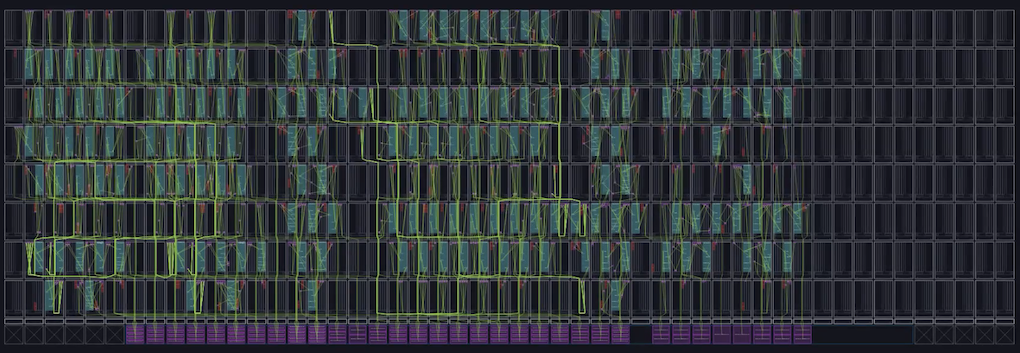 Belle II calorimeter trigger floorplan on AMD VCK190 AI engines © Marc Neu/KIT
ErUM-Data framework
The ErUM-Data action plan, funded by the Federal Ministry of Research, Technology and Space (BMFTR), supports digitization in basic research at large-scale facilities. Its goal is to fully exploit the potential of data and digital methods for exploring the universe and matter. The program promotes collaboration between physics, computer science, and engineering, and strengthens the transfer of digital tools and expertise across disciplines. Projects in the ongoing call are funded for three years from 2025-2028.
The DEEP project
DEEP - Data Efficiency in Embedded Processors - addresses the growing challenge
of managing the massive data volumes generated by modern research infrastructures such as particle
accelerators and photon sources. These facilities will soon produce data rates far beyond what
conventional computing systems can process or store sustainably.
DEEP develops methods to process and reduce data directly at the source by integrating
machine-learning algorithms into embedded processors close to the sensors. This local
processing increases data efficiency, reduces transmission and storage needs, speeds up
decision-making, and lowers energy consumption.
Technical focus
The project targets heterogeneous system-on-chip (SoC) architectures that combine CPUs, GPUs, FPGAs, and reconfigurable cores. These platforms offer high performance and low latency but require specialized development methods. Conventional ML frameworks such as PyTorch or TensorFlow cannot be applied directly, and hardware design remains complex. DEEP develops the missing software tools, design flows, and optimization strategies to make real-time ML on such hardware practical.
Competence center and collaboration
DEEP acts as a virtual national competence center for system-on-chip technologies within the ErUM-Data community. It connects expertise from experimental particle physics, control and electronic engineering, and industrial partners. Together, the partners develop standardized approaches, provide open reference implementations, and demonstrate their use in realistic pilot projects at large research facilities.
Through collaboration with associated partners and international initiatives, DEEP promotes the transfer of knowledge and technology between fundamental research and applied systems development.